

The Thalangama Area
WILDLIFE AND PROTECTION STATUS
 Click to zoom
The Thalangama tank and its environs were declared as an Environmental Protection Area (EPA) under the National Environmental Act (Gazette Extraordinary No. 1487/10, dated 5th March 2007). There are 14 such areas in Sri Lanka, of which the Yala National Park is best known.
The Gazette was amended in 2021 to allow the construction of an elevated highway passing the paddy fields and smaller Averihena tank which resulted in public protests. The amendment was subsequently revoked and the amended Gazette removed from the database. Due to its protected status, only certain defined land use types are permitted, like traditional fishing and paddy cultivation.
The extent of the Environmental Protection Area (see map) is approximately 118 hectares (Central Environmental Authority [CEA]). According to the National Wetland Directory of the CEA and other surveys its habitat includes the 500-year-old Thalangama tank and the more recently constructed Averihena lake as well as freshwater swamp forests, grasslands and about 83 ha under paddy rice. The area is a biodiversity hotspot hosting seasonally about 100 different species of migratory, resident and endemic birds. A summary of one biodiversity survey is presented below as well as references of other surveys of flora and fauna in the area.
A particular threat to the ecological balance is, for example, the release of non-native fish into the lake. Another ecological challenge is the fast growth of invasive plant species like the Wel Atha trees (Pond or Monkey Apple (Annona glabra)), water hyacinths (Eichhornia crassipes) and Salvinia on the lake surface. While the Wetland Watch is keeping since several years the spread of Water Hyacinths on the Thalangama lake under control, other water weeds, like Salvinia or the submerged invasive Coontail and Bladderwort remain a challenge.
Among the endemic and endangered mammals, the Purple-faced leaf monkey is the noisiest and most visible around the lake, but also the one most disliked by local residents who fear for their phone lines and roofing sheets. The western purple-faced langur which is the subspecies living around the lake is one of the 25 most endangered primates in the world. There are also endemic and endangered fish species in the lake, and the highly protected Fishing cat and the Sri Lankan jackal.

Photos: Thikula Samaradivakara (Jackel), Pay Drechsel (Langur), Vidura Gamini Abhaya (Fishing Cat).
At least four biodiversity inventories were carried out at the Thalangama lake. The information presented here was extracted from the Environmental Impact Assessment of 2016 for the Madiwela East Diversion Scheme project (Part 1; link below).
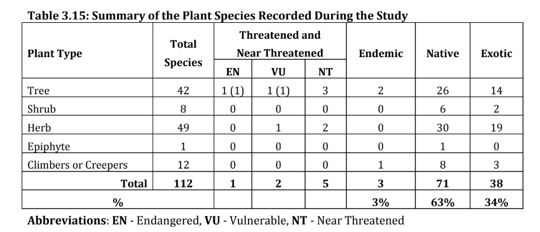
Three plants, Argyreia populifolia (Giri Tilla), Areca concinna (Lenteri Puwak) and Cinnamomum zeylanicum (Kurundu) of the recorded species within the project area are endemic to the country. The assemblage recorded within the project area also included three plant species, Areca concinna (Lenteri Puwak), Cinnamomum zeylanicum (Kurundu), Aponogeton crispus (Kekatiya) listed as Nationally Threatened. Out of the recorded nationally threatened plant species, Areca concinna (Lenteri Puwak) is listed as Endangered (EN) and other two species are listed as Vulnerable (VU). In addition, four species of plants, Ceratopteris thalictroides, Cyclosorus interruptus, Carallia brachiata (Dawata), Madhuca longifolia (Mi), Vitex altissima (Milla) listed as Nationally Near Threatened (NT) was also observed within the study area.
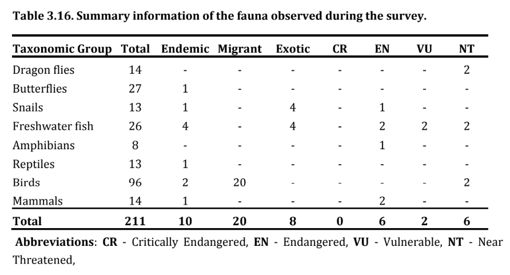
The faunal assemblage included 10 species that are endemic to Sri Lanka and eight species that are listed as nationally threatened species. Faunal species that are of high conservation value include Semnopithecus vetulus (Purple-faced leaf monkey) an endangered and endemic primate, Prionailurus viverrinus (Fishing cat) an endangered small cat, Ixobrychus sinensis (Yellow bittern) a near threatened bird species, Hylarana aurantiaca (small wood frog), an endangered frog species, Aplocheilus dayi (Day’s killifish) an endemic and endangered fish species, Rasborides atukorali (Horadandiya) an endemic and vulnerable fish species and three Orthetrum glaucum (Asian Skimmer), Orthetrum luzonicum (Marsh Skimmer), Orthetrum pruinosum (Pink Skimmer), near threatened dragon flies.
Sources:
CECB 2016. Environmental Assessment (EA) for the Proposed Project on Madiwela East Diversion Scheme – Part 1. (2016) Improvements to Thalangama and Avarihena Tanks (Assessment done mid-2015 by University of Colombo) https://drive.google.com/file/d/0By822Y-m4d8BMlE5c24tZ3hzYkk/view?resourcekey=0-02tAbxIDTkdA1CJXm8sr0g
Other wildlife inventories for the Thalangama lake can be found here:
Government of Sri Lanka 2011. METRO COLOMBO URBAN DEVELOPMENT PROJECT (MCUDP). Environmental assessment Final Report-Nov 2011 Vol. 1 https://documents1.worldbank.org/curated/en/927231468102547422/pdf/E28860v10EA0P10P0GreenTech0Nov02011.pdf (see page 77 and annex 8, Tables 9, 10, 14)
Podduwage D.R. et al., 2015. Assessment of Selected Classes of Fauna at Thalangama Wetland (Assessment done Feb 2013 - March 2014) https://www.researchgate.net/publication/341232205_Assessment_of_selected_classes_of_fauna_at_Thalangama_Wetland_-_WETLANDS_SRI_LANKA
Signes. 2016. METRO COLOMBO URBAN DEVELOPMENT PROJECT (MCUDP). Consultancy Services for the Preparation of a Management Strategy for Wetlands and Carrying out an Assessment of Water Quality in the Inland Waterways and Lakes within Metro Colombo Area. Technical Report 02: ECOLOGICAL STATUS. WETLAND MANAGEMENT STRATEGY. (Assessment done April - June 2015) Online link =? Softcopy can be provided by the Thalangama Wetland Watch